Free shipping on orders over $100

Why Are Humans Naturally Attracted to Curved Shapes? The Science Behind Beautiful Design
7/9/20264 min read

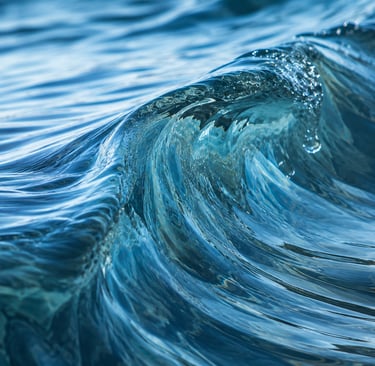
Why Do Curved Shapes Feel More Beautiful?
Have you ever wondered why ocean waves, flower petals, smooth stones, flowing rivers, and handcrafted glass often feel naturally calming and visually appealing? Scientists have been studying this question for decades, and the answer lies in the fascinating intersection of neuroscience, evolutionary biology, cognitive psychology, and design science.
Research suggests that humans are naturally attracted to curved shapes because our brains process them differently than sharp, angular objects. This preference isn't simply personal taste—it reflects millions of years of evolution combined with the remarkable way our nervous system interprets visual information.
Whether we realize it or not, the shapes surrounding us influence our emotions, attention, and even our perception of beauty.
The Brain's Response to Curved Objects
The human brain constantly evaluates the environment for both opportunities and potential threats. Long before conscious thought occurs, visual information travels through multiple regions of the brain that determine whether something appears familiar, safe, or potentially dangerous.
Functional magnetic resonance imaging (fMRI) studies have shown that people consistently rate curved objects as more attractive than objects with sharp, angular edges. Researchers have also observed increased activity in areas of the brain involved in aesthetic appreciation when participants viewed smooth, flowing forms.
At the same time, angular objects often produce greater activation in the amygdala—a small structure deep within the brain responsible for detecting possible threats.
The amygdala evolved to help humans survive. Throughout history, sharp objects frequently represented danger:
Thorns
Broken branches
Jagged rocks
Teeth
Weapons
Because of this evolutionary history, the brain often interprets sharp angles with greater caution, even when there is no actual threat.
Curves, by contrast, generally signal safety. As a result, the brain can devote more attention to appreciating their form rather than evaluating potential risk.
Evolution and Human Survival
Evolution has shaped nearly every aspect of human perception.
For hundreds of thousands of years, our ancestors depended upon rapid visual processing to make survival decisions. Identifying dangerous objects quickly could mean the difference between life and death.
Natural environments provided countless examples of smooth, flowing forms:
Rolling hills
Ocean waves
River bends
Clouds
Leaves
Flower petals
Human faces
The contours of the human body
Because these forms appeared repeatedly throughout nature, the human visual system became exceptionally efficient at processing them.
Scientists believe this long evolutionary relationship may explain why curved forms continue to evoke feelings of comfort and familiarity today.
Processing Fluency: Why Curves Feel Effortless
One of the most important concepts in cognitive psychology is known as processing fluency.
Processing fluency describes how easily the brain can interpret incoming information.
When information is processed quickly and efficiently, people often experience positive emotions without consciously recognizing why.
Curved lines naturally guide the eye along continuous paths.
Instead of stopping abruptly at corners, the eyes move fluidly across the object.
This creates:
Reduced visual effort
Faster object recognition
Greater visual comfort
Increased aesthetic appreciation
Simply put, curved designs require less mental work for the brain to understand.
Our brains often interpret this efficiency as beauty.
Gestalt Psychology and Visual Harmony
Another explanation comes from Gestalt psychology, a field dedicated to understanding how humans organize visual information.
Rather than seeing thousands of individual lines and shapes, the brain automatically combines information into complete, meaningful patterns.
Curved forms support one of Gestalt psychology's central principles: good continuation.
Instead of interrupting visual movement, curves encourage the eyes to continue naturally across an object's surface.
This creates a stronger sense of:
Unity
Balance
Flow
Harmony
These characteristics are often associated with elegance and sophisticated design.
The Mathematics Hidden Within Nature
Nature itself is filled with curves.
Many of these forms are not random—they follow surprisingly precise mathematical patterns.
Scientists frequently observe curved structures generated by:
Fibonacci sequences
Logarithmic spirals
Fractal geometry
Surface tension
Fluid dynamics
Examples include:
Seashells
Ferns
Hurricanes
Galaxies
Flower petals
Ocean waves
Even water naturally forms smooth curves because surface tension causes molecules to minimize energy.
The result is a world dominated by flowing forms rather than rigid angles.
Humans have evolved within this environment for millions of years, making these natural patterns deeply familiar.
Design Psychology and Modern Products
Modern industrial designers understand these principles remarkably well.
Whether designing furniture, automobiles, architecture, or carefully crafted glass, many professionals intentionally incorporate curved forms because they influence how people emotionally respond to an object.
Research in design psychology has repeatedly shown that curved products are often perceived as:
More inviting
More comfortable
More elegant
Higher quality
Easier to use
This doesn't mean straight lines are undesirable.
Instead, the careful balance between curves and structure creates products that feel both functional and visually refined.
Many timeless designs rely on this balance.
Why Materials Matter
Shape is only one part of exceptional design.
Materials influence how an object reflects light, distributes temperature, feels in the hand, and ages over time.
At Pink BlueJay, we appreciate the craftsmanship behind carefully selected body-safe materials, including premium borosilicate glass.
The remarkable clarity of borosilicate glass allows light to travel through smooth curves in ways that highlight the beauty of its design. Reflections, transparency, and gentle contours work together to create an elegant visual experience rooted in both science and craftsmanship.
If you're interested in learning more about materials, explore our educational article on How Borosilicate Glass Is Made, where we explain the fascinating manufacturing process behind one of the world's most durable specialty glasses.
You may also enjoy our guide to Body-Safe Materials, which explores why material quality plays such an important role in thoughtful product selection.
Beauty Is More Than Personal Preference
Beauty isn't simply something we "like."
It is the result of incredibly complex interactions between:
Neuroscience
Human evolution
Visual perception
Cognitive psychology
Mathematics
Natural patterns
Design engineering
Every curve we admire reflects millions of years of biological adaptation combined with the remarkable efficiency of the human brain.
Understanding the science behind curved shapes reminds us that beautiful design is rarely accidental. It is the product of nature, psychology, craftsmanship, and thoughtful engineering working together.
At Pink BlueJay, we're passionate about sharing educational content that explores the fascinating science behind materials, craftsmanship, and beautiful design. We believe understanding why something feels beautiful makes us appreciate thoughtful design even more.
© 2025. All rights reserved.
Discover premium adult pleasure products from Vancouver Island.